
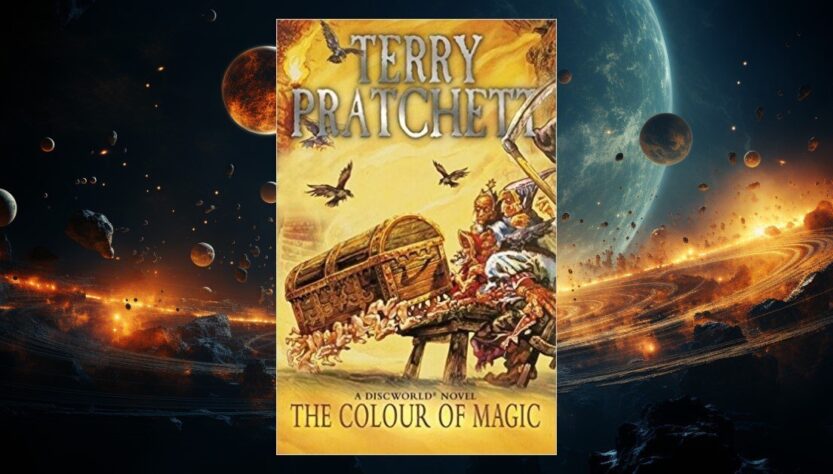
There are books you enjoy, books you remember, and then there are books that quietly rewire something in you. The Colour of Magic is the third kind. I’ve read it more than once, I’ve now read every single Discworld novel plus a good chunk of the companion material, and I can tell you with complete honesty that this is not Pratchett’s best work. It is also, somehow, one of my favourite books of all time. Those two things are not in conflict.
Published in 1983, this is the book that started everything. A flat world balanced on the backs of four elephants, themselves standing on the back of a giant turtle called Great A’Tuin, swimming through space in the direction of… well, that’s a question that obsesses the Disc’s philosophers. From this gloriously daft premise, Pratchett introduces us to Ankh-Morpork, the city that will become one of fiction’s great settings, a place described as having the consistency of a very old cheese and roughly the same smell.
Our reluctant guide through all of this is Rincewind, a wizard who never actually managed to learn any spells (one very powerful spell lodged itself in his mind early on and frightened everything else away). Rincewind is a coward, a failure, and almost certainly the most relatable character in fantasy literature. His companion is Twoflower, the Disc’s first tourist, a cheerful little man from the Agatean Empire who carries a box with hundreds of tiny legs and a very literal-minded approach to adventure. The Luggage, as it becomes known, is sapient pearwood, intensely loyal, and will follow its owner absolutely anywhere. It will also eat anyone who gets in the way. It is immediately one of the great comic creations in fiction.
What Pratchett is doing in this book, on one level, is a fairly gleeful parody of heroic fantasy. The Disc’s greatest hero, Hrun the Barbarian, is basically every Conan archetype distilled down to muscle and monosyllables. The plot bounces through set pieces that riff on swords-and-sorcery conventions with genuine affection and considerable wit. If you came here from Robert E. Howard, Fritz Leiber, or Michael Moorcock, you will recognise exactly what’s being skewered and love it all the more.
But there’s something else going on too. The Gods of the Disc are real, and occasionally bored, and they play games with mortals on a board in a place above the clouds. Death shows up repeatedly, speaking in CAPITALS, with what can only be described as professional curiosity about Rincewind specifically. The book has a strange, dreamlike quality in places, particularly towards the end, that suggests Pratchett was already thinking about something deeper than parody. The Disc is a place where narrative itself has weight. Stories matter. The shape of a story can bend reality. He’d explore this idea far more explicitly later, but the seed is here.
The Honest Part
The Colour of Magic is more episodic than structured. It reads almost like connected short stories rather than a single novel, which reflects how it was originally published. The characterisation is thinner than what Pratchett would later achieve. Rincewind hasn’t yet found his full voice. The jokes are good but not yet the sustained, almost unbearable brilliance of Small Gods or Night Watch or Going Postal. If someone handed you this book cold with no context, you might enjoy it without quite grasping why so many people treat Pratchett as something close to sacred.
Which is why I’d never hand it to someone cold. I’d tell them what I’m telling you: this is the beginning of one of the greatest long-form comic achievements in English literature. Reading it now, knowing everything that follows, is a different experience entirely. You can see Ankh-Morpork in early construction. You can see Pratchett figuring out the rules of a world he’d spend forty years building. The octarine, the eighth colour of the spectrum visible only to wizards, feels like a throwaway joke the first time you encounter it; by the end of the series you understand it’s a metaphor for everything the books are about. Magic is real, imagination is real, and the world looks completely different if you’re one of the people who can see it.
The Rincewind books are not where the series peaks, it’s worth saying. If you fall in love with The Colour of Magic and come back for more, you will find even richer territory in the Death storyline (Mort, Reaper Man, Soul Music), the City Watch novels starting with Guards! Guards!, and the standalone Small Gods, which is probably the sharpest thing Pratchett ever wrote. But Rincewind is where it starts, and there’s a pure anarchic energy to these early books that the later, more sophisticated novels sometimes trade for depth. Both things are worth having.
There’s also the matter of what Pratchett was building underneath all the jokes. He was writing about how stories shape reality. He was writing about how we collectively agree to believe things and how that belief creates something real. He was writing about competence and incompetence, about luck and fate, about what it means to keep going when you are objectively terrible at the thing you’re trying to do. Rincewind survives not through skill but through an almost supernatural talent for running away and an extremely vague relationship with doom. Forty books later, that character note still makes me laugh.
If you haven’t read Discworld and you’re looking for somewhere to start, this is the obvious place, though I’d tell you to commit to at least the first two (The Colour of Magic leads directly into The Light Fantastic, which concludes the story). If you have read Discworld and you’re thinking of revisiting the beginning, absolutely do it. It’s a different book once you know the whole architecture. The foundations look a lot sturdier when you know what was built on top of them.
On the Audiobook
The 2022 Penguin Audio edition is genuinely something special. Colin Morgan, best known for Merlin, narrates the main text with real warmth and a gift for comic timing. Bill Nighy reads the footnotes, which is an inspired piece of casting that makes you realise how essential those footnotes actually are. And Peter Serafinowicz voices Death, which is perfect, because Death needs to be both funny and genuinely unsettling, and Serafinowicz achieves both. The whole production runs 7 hours and 58 minutes and feels considerably shorter. It’s one of the better audiobook productions I’ve encountered.
Rating: 5/5
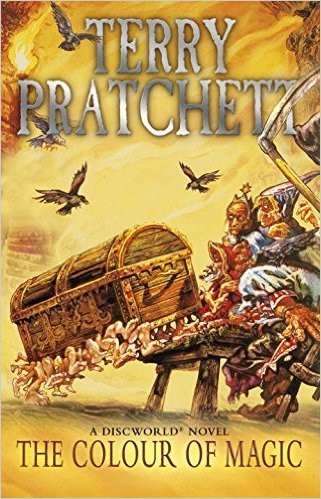
The Audible UK edition is narrated by Colin Morgan, with Bill Nighy reading the footnotes and Peter Serafinowicz as the voice of Death. It runs to 7 hours and 58 minutes.
Discover more from Unfolded Universe: Sci-Fi Book Reviews
Subscribe to get the latest posts sent to your email.